News, Articles
& Trends

Modern Vertical Menu

Join Our Community

Current Articles | RSS Feed RSS Feed

American Giving Continues Slow, Consistent Recovery


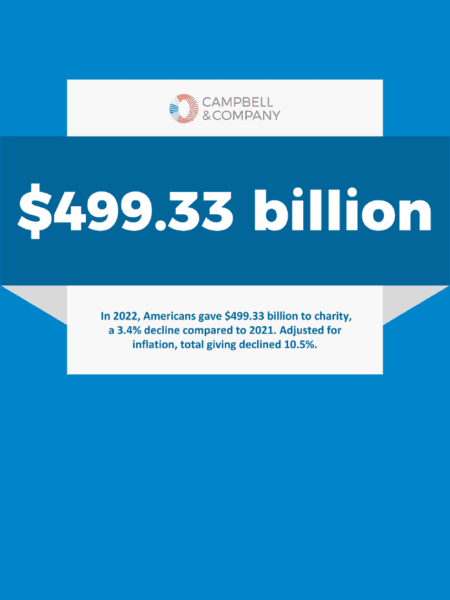
Americans gave an estimated $316.23 billion to charitable causes in 2012, representing 3.5 percent growth (1.5 percent adjusted for inflation) from the previous year, according to Giving USA 2013: The Annual Report on Philanthropy. While this continues the trend of growth that we have observed since the recession, the current pace suggests that it could take another six to seven years for giving to return to pre-2008 levels. Because giving closely tracks the economy at large, key economic factors (personal income, personal consumption, employment levels and investment markets) could alter this pace and the overall level of giving further.

"Overall, growth in giving was restrained. But there are signs that individuals, the largest source of giving, are beginning to consider more asset-based giving. This development could be quite positive going forward," says Peter Fissinger, President & Chief Executive Officer of Campbell & Company, a national fundraising consulting and executive search firm. "By continuing to strategically build relationships with their best donors and prospects, nonprofits can help ensure their sustainability and growth in these challenging times."

Other key findings from Giving USA 2013 include:

Giving by Source

describe the image

  • Individual giving rose to $228.93 billion, a 3.9 percent increase (1.9 percent adjusted for inflation) over 2011. This figure may have been checked by economic uncertainty, which resulted from contrasting positive and negative indicators, including growth in the S&P 500, slightly higher home values, lower unemployment and reduced gas prices coupled with budget and tax reform debates.

  • Corporate giving, including cash gifts, in-kind contributions, and corporate foundation grants and gifts, rose to an estimated $18.15 billion, a 12.2 percent increase (9.9 percent adjusted for inflation) from 2011 levels. Significant in-kind gifts from major pharmaceutical companies drove an appreciable portion of this growth.
     

Giving by Sector

Giving by Sector

About Giving USA Foundation™

Giving USA is a public outreach initiative of Giving USA Foundation™, which was established by the Giving Institute to advance philanthropy through research and education. Headquartered in Chicago, the Foundation publishes data and trends about charitable giving through its seminal publication, Giving USA, which has documented who gives what to whom for more than 50 years, and quarterly newsletters on philanthropy-related topics. To learn more visit www.givinginstitute.org.

How to obtain Giving USA 2013

Giving USA is the longest running and most comprehensive report on American philanthropy. A free executive summary of Giving USA 2013 can be downloaded online at www.givingusareports.org. Other products include the complete report; Giving USA Spotlight – quarterly research reports; and PowerPoint presentations for board meetings. Use the code CAMS1131 to receive 10% off any Giving USA products. 

Join the Conversation!

You can follow and join in the conversation on Twitter using the tag #GivingUSA2013.  

Campbell & Company is holding Giving USA programs in Chicago, Cleveland, Los Angeles, Silicon Valley, and Washington, DC, as well as a national webinar.

To learn more about our events, click here

Campbell & Company is a national consulting firm offering advancement planning, fundraising, communications and executive search services for nonprofit organizations in the education, health and medicine, arts and culture, environment, social service, and professional society fields.

Through thirty-seven years and thousands of engagements, Campbell & Company has helped nonprofit organizations anticipate and manage the challenges of the philanthropic marketplace. The company maintains offices in Chicago, Los Angeles, Portland, the San Francisco Bay Area and Washington, DC. For more information, please telephone (877) 957-0000 toll free, email info@campbellcompany.com or visit www.campbellcompany.com.

Building a Strong, Compelling and Consistent Case for Support


writingIn Case Development 201, Director of Communications Consulting Andrew Brommel offers  a collection of practical, immediately applicable  “tips and tricks” for building a strong, compelling, and consistent case for support.

For Brommel, an organization’s case for support is ultimately “your message to your donors—why should they give to your organization?”  He asserts that, “If this is all we ever thought about with a case for support, we’d be fine.”

Just as a case for support should be comprehensive in reflecting an organization’s vision, it should be a collective effort—one that engages Board members, staff, and leadership in the composing and shaping process. Messaging, Brommel argues, is “the most important. It’s the core … This is where your case comes from, and everything else we’re talking about is secondary to this.”

Effective messaging should express only one key idea per message, and should have an edge or make an assertion—not “ a statement of something this is universally, obviously true.” Brommel asserts that, in the non-profit sector, “we probably do too much writing, and not enough messaging.”

Two key benefits of establishing, clear, consistent messaging is that everyone in your organization, from volunteers to Board members, is pulling from the same unified, agreed-upon points, keeping communications consistent. In addition, these messages are endlessly versatile, and are easily transferrable to writing documents, talking points, and PowerPoint, video, or iPad presentations.

As a sample format for these messages, Brommel suggests you “throw a headline up there, and give it a few supporting points.” While the headline takes a position, each supporting point will elaborate on and clarify this position.

To write effective, clear messaging of your own, try this process:

  • Write 3-5 messages that simply “get your donor from Point A to Point B,” or from a lack of engagement to deep involvement.

  • To start, establish that an issue exists, and why it matters

  • Then, credential your organization as an effective institution to address the issue. Use this message as an opportunity to differentiate yourself from other organizations with similar missions

  • Next, assure potential donors that you have a plan in place that will enact real change

  • Remember, that you can often make a stronger statement by saying less

In the following examples, Brommel uses pairs of weaker and stronger messages to demonstrate how to build the most effective, specific messages for your organization:

1. Have conviction. Make a strong statement.

Weak: Our university helps students build the skills they need to become leaders.

Stronger: We believe every student has the power to lead.

2. It’s not about you. It’s about the people you serve.

Weak: We believe our community needs a healthcare provider committed to caring for us all.

Stronger: We believe everyone in our community deserves great healthcare.

3. Think voiceover, not prose. Short and to the point.

Weak: Among all the ways we can invest in our school’s future, the endowment is the most important, ultimately surpassing the impact of capital and program investments.

Stronger: The endowment is the most important investment we can make in our school’s future.

4. Don’t say everything. Say what matters.

Weak: As a nonprofit, community-based organization, we rely on the philanthropic support of our donors and neighbors to make our work possible.

Stronger: Only you can make our work possible.

For more helpful tips on developing a strong case for support, including use of stories and statistics, the three crucial levels to think about in all case development, and more specific examples, watch Andrew Brommel’s webinar, Case Development 201, here.

Questions? Contact Andrew Brommel at andrew.brommel@campbellcompany.com.

Campbell & Company Announces First Look: Giving USA 2013


Campbell & Company announces a series of dynamic events around the forthcoming Giving USA 2013 report, which will be released at 12:00 a.m. ET, on Tuesday, June 18, 2013.

Giving USA 2013 series of events will give you a powerful tool for understanding and navigating the current philanthropic environment. You will learn about broad and sector-specific philanthropic trends, potential opportunities and challenges going forward, and implications for your fundraising goals and strategies.

The First Look events will include:


Join in and follow the conversation on Twitter using the tag #GivingUSA2013.

Campbell & Company is a proud sponsor of Giving USA. Giving USA 2013, was compiled by The Center on Philanthropy at Indiana University for the Giving USA Foundation.
 

About Campbell & Company

Campbell & Company is a national consulting firm offering advancement planning, fundraising, marketing communications and executive search services to nonprofit organizations in nearly every sector. Through thirty-six years and more than a thousand engagements, we have helped our clients anticipate and manage the challenges of the philanthropic marketplace. Our offices are located in Chicago, Portland, Los Angeles, the San Francisco Bay Area and Washington, DC. For more information, please call toll-free (877) 957-0000, email info@campbellcompany.com or visit www.campbellcompany.com.

New Study: CDO Confidential - What CDOs Want You To Know About Retention


 A National Study on Nonprofit Chief Development Officer Retention

Chicago, IL - A newly released study CDO Confidential: What CDOs Want You to Know about Retention reveals that unrealistic expectations set by management have reduced the average Chief Development Officer (CDO) tenure to one to two years. Other factors include a lack of sufficient resources and cooperation among CDOs, CEOs and Boards. Campbell & Company, a national nonprofit consulting and executive search firm, recently completed a nationwide survey to understand the reasons behind this trend. CDO Confidential received responses from more than 400 Chief Development Officers and Chief Executive Officers to gain multiple perspectives. The sample included organizations with a wide range of missions, budgets, staff sizes and geographic areas.  

“This study shows that the CDO retention is not an insulated issue,” says Marian Alexander DeBerry, Director, Executive Search at Campbell & Company. “Shorter tenure in leading development roles not only leads to difficulty maintaining donor relationships, but also hinders the development and execution of long-term fundraising strategies. The implications of having short tenure are vast ranging from attracting and evaluating talent to onboarding to succession planning and require a wider, more in-depth dialogue with all parties involved.”  

Key findings include:

The report, CDO Confidential: What CDOs Want You to Know about Retention describes four main challenges:

Short tenure

Fifty-two percent (52%) of CDO served one to two years in their most recent position, confirming anecdotal evidence of shorter tenures.  

Unrealistic expectations

CDOConfidential

CDOs (75%) and CEOs (62%) cited unrealistic expectations are the number one reason behindCDO turnover.  

Reasons for departure

Twenty-eight percent (28%) of CDOs cited their organization’s lack of understanding of development as a reason for their most recent departure.  

Inadequate resources

Fifty-eight percent (58%) of CDOs felt they did not have the resources to do their job effectively, and twenty-nine percent (29%) of CDOs indicated professional development as their primary need.  

Click here to access the CDO Confidential report.

Campbell & Company is holding a series of conversations to discuss strategies to lengthen CDO tenure. Tips and strategies from these conversations will be released in future articles.

  • On Wednesday, April 24, at 12:00 PM CST Andrew Smerczak-Zorza, Consultant, Executive Search, led a panel discussion regarding the results of the survey during a Campbell & Company webinar.

  • On Wednesday, May 22, from 8:00 - 10:30 AM CST, Marian Alexander DeBerry, Director, Executive Search together with CompassPoint, will discuss the findings of two independent surveys, CDO Confidential and UnderDeveloped, during a luncheon at the Donors Forum.

Additional Resources

About Campbell & Company

Campbell & Company’s Executive Search team connects organizations with visionary leaders who can drive continued growth. We pay careful attention to the nuances and complexities of each client and draw on our extensive networks to find the ideal fit. Campbell & Company maintains offices in Chicago, Portland, Los Angeles, the San Francisco Bay Area and Washington, DC. For more information, please call toll-free (877) 957-0000, email info@campbellcompany.com or visit campbellcompany.com.

Peter Fissinger Quoted in the Chronicle on Midcourse Reviews


Nonprofits often raise more money when they review what's working and what's not argues the recent article Midcourse Reviews Can Make for Better Capital Drives in the Chronicle Of Philanthropy.

thechronicle

Midcourse corrections have become increasingly common in the charity world. Reasons vary from ambitious goals to a tough economy. Some experts now believe big fundraising drives are unlikely to succeed without a midway review, whether it is conducted internally or by outside consultants.

Peter Fissinger, President & Chief Executive Officer at Campbell & Company, sat down with the Chronicle to discuss midcourse reviews during a capital campaign. Mr. Fissinger stressed the importance of flexibility in planning not only to reach reasonable goals but to maintain a healthy morale among the volunteers.

Read the complete article here.

Edith Falk Quoted in Crain’s on the Price of Board Membership


Each year, board members face the required “give-or-gets”— the stated minimum annual donations board members either must give out of their own pockets or solicit from a corporation or well-heeled friend.

index

The give-or-gets guarantee a revenue stream each year and help ensure that board members   are invested in the organization and its mission. Fundraising experts predominantly praise give-or-gets as a sound nonprofit tool. However, there are drawbacks and not every nonprofit has the give-or-get policy.

Edith Falk, Chair of Campbell & Company, recently gave her take on how nonprofits use the give-or-get tool with Crain’s Chicago Business. "Some are very squeamish about putting a dollar amount there," says Edith Falk, Chair of Campbell & Company, a Chicago-based consultant to nonprofits. Ones that do "can be reluctant to publicize it," Ms. Falk says, fearing "unintentional consequences," for instance appearing too elite—or not elite enough.

For the complete story and a sampling of give-or-gets from nine local nonprofits click here.

Angie Joens at CASE on Digital Communication & Stewardship


We have heard experts say that the digital world will open the door to better donor communication and stewardship. Harnessing the benefits of these tools requires some preparation.

describe the image

Campbell & Company’s Angie Joens, Donor Relations/Stewardship Consultant, recently spoke at the Advancement Talk segment of CASE where she discusses the fundamentals an institution should have in place before it uses the latest technology to steward donors and alumni.

Also, hear why Ms. Joens believes donor relations offices should hire and mentor the next generation of advancement professionals.

About Campbell & Company

Campbell & Company is a national consulting firm offering advancement planning, fundraising, marketing communications and executive search services to nonprofit organizations in nearly every sector.

Through thirty-six years and more than a thousand engagements, we have helped our clients anticipate and manage the challenges of the philanthropic marketplace. Our offices are located in Chicago, Portland, Los Angeles, the San Francisco Bay Area and Washington, DC. For more information, please call toll-free (877) 957-0000, email info@campbellcompany.com or visit www.campbellcompany.com.

Bill Hausman Retires from Campbell & Company after 26 Years


Bill HausmanCampbell & Company announces the retirement of Senior Vice President Bill Hausman, who departs after more than 26 years of exemplary service. Mr. Hausman served approximately 100 different nonprofits during his tenure, which included many extensive, long-term relationships.

Peter Fissinger, Campbell & Company President and Chief Executive Officer remarks, “Bill has been a trusted partner for his clients, a venerable leader at our firm and a remarkable inspiration to many more.  We celebrate his achievements as he begins this new chapter in his life.”

Mr. Hausman will continue serving the nonprofit community as a board trustee for Rockport Music Festival and volunteer at his church. He is also excited to spend more time with his two young grandchildren, his gardens, and many unread books.

We recently sat down with Mr. Hausman, who shared his insights into how fundraising has changed throughout his career and where it may be going.

Q. How has fundraising changed over the last 26 years?

A. I’m beginning to sense that many philanthropists are making larger commitments but to a smaller number of organizations. There was a time when people gave smaller gifts to a range of nonprofits; however, I think donors are now more focused on supporting the causes and organizations closest to their hearts. They’ve realized that focusing their giving lets them make more of a difference; not to mention, it cuts down on the amount of direct mail they receive [CHUCKLES]. 

Furthermore, because of economic uncertainty, I’ve seen more individuals willing to consider larger one-time gifts rather than multi-year pledges and I sense a growing interest in planned gifts. At the same time, many people seem less willing to make outright gifts to endowment.

Q. Where do you see fundraising in the next 26 years?

Past trends are typically the best indicators in situations like this. American giving has steadily risen over the past 40 years, so I would wager that GivingUSA 2030 will reflect a continuous increase in philanthropy. But as donors focus their giving, there will be fewer nonprofits competing for donor support, as organizations merge or disappear. 

There will always be nonprofits focused on helping those in need; however I fear that these organizations will not develop or sustain the level of sophistication that others, like higher education institutions or healthcare systems have achieved.

I think it is a real challenge to engage the next generation of philanthropists especially in a society where religious values play less of a formative role in training people to be generous.  As fundraising professionals, we need to reach younger people and demonstrate the value of their support. And, as parents, mentors and teachers, we need to instill the values that have led us to give so generously of our time and funds. 

I’m proud to have spent the past 26 years helping nonprofit organizations carry out their missions, and I look forward to seeing what the future holds for philanthropy and for the work of nonprofit organizations.

About Campbell & Company
Campbell & Company is a national consulting firm offering advancement planning, fundraising, marketing communications and executive search services to nonprofit organizations in nearly every sector. 

Through thirty-six years and more than a thousand engagements, we helped our clients anticipate and manage the challenges of the philanthropic marketplace. Our offices are located in Chicago, Portland, Los Angeles, the San Francisco Bay Area and Washington, DC.  For more information, please call toll-free (877) 957-0000, email info@campbellcompany.com or visit www.campbellcompany.com.

###

The Data Plan: Where Science Meets Art


While philanthropic giving is making a rebound from the bleakest years of the recession, the challenge to capture donors’ interests, understand their needs, engage them, and convert into lifelong donors remains.

Donor analytics can help you uncover and realize your philanthropic potential, but the scale and complexity of these services can be overwhelming. Organizations need to develop clear plans for using their data to drive decision-making and fundraising.

A recent Campbell & Company webinar provided guidance on this very topic from Carrie Dahlquist, Campbell & Company Director of Strategic Information Services, and Jeff Wilklow, Campbell & Company Vice President. During the session, they discussed the evolving role that data is playing, both strategically and tactically, in development programs. Additionally, they discussed the process for collecting and using information effectively.

Data Appends can add value

The first step is to start with a clean prospect list. While most organizations are pretty good about making periodic updates from National Change of Address (NCOA) reports, traditional mail is only one method of connecting with current and potential donors. Email and phone contacts are just as important today. Relatively inexpensive “data enrichment” services can provide you with email and phone appends in addition to changes in marital status, age updates and lists of donors who have passed. Carrie Dahlquist advises that keeping this information up-to-date can allow greater options for contacting constituents and can help in segmentation and engagement strategies.

Analyze Publically Available Information and Your Own Data

Now more than ever, when we are all competing for a smaller philanthropic pool, it is important to prioritize staff time and effort on the “right” prospects. There are a number of “indicators” that can help inform this process, and they generally revolve around capacity and inclination.

Some of this information is available publicly, and there are vendors that provide electronicData Resources screening services, which access and aggregate information on wealth, assets and philanthropic affiliations. This can help you identify who has capacity and may warrant additional review.

Either in-house, or working with a vendor, you can also use predictive modeling to analyze records in your own database and identify prospects who share characteristics with your major gift donors. This can help you develop a profile of your “best donor” so you can develop better segmentation and engagement strategies.

If working with a vendor isn’t in the budget, there are simple steps you can take to begin to segment your database. For example, creating a RFM (Recency, Frequency, Monetary) score is an easy way to prioritize prospects based on their previous engagement with the organization. 

Any of these data points will help further inform your knowledge of your prospect base and provide insights into how to prioritize. Using them together can provide even greater clarity, helping you find prospects who have potential but who might not be in your major-gift sightline.

Once you begin to prioritize your prospects and prepare for further interaction, you can also use data to learn more about them before establishing connection. As Carrie explains, “As we prepare to qualify our potential prospects, it’s helpful to learn about their career, other philanthropic commitments, hobbies, community and professional networks. These all can help to initiate a more personal conversation and focus on how they might want to be further engaged.”

Worksheets on the Campbell & Company website can help build these databases, and we have compiled a list of fee-based and free resources as well. One note of caution: If you are using electronic screening, it is important to dedicate a portion of someone’s time to vetting and verifying the information.

Leverage data to manage

So you’ve got all of this data, now what do you do with it? You needn’t reserve this great information only for major gift programs and campaigns. Once you’ve determined which top prospects will be individually managed, you can use the data to think through engagement and cultivation strategies for other key groups of prospects who will not be managed one-on-one. And you can track your progress using metrics.

Metrics vary by program area, but developing a set of metrics that links to the broader mission and tracks progress is essential. And more often organizations are using metrics in scorecards to manage their programs. Campbell & Company has sample lists of metrics by program area as well as a sample scorecard here. While each organization may find a different set of metrics and scorecard format meaningful, the goal is to ensure programs are on track and we have transparency with key stakeholders.

Have a plan for implementation

But all too often organizations collect data and then don’t use it effectively. Jeff Wilklow warns, “there may be a tendency to get an analyst in-house and have them develop all sorts of information for you without an idea for how it will be used. I also hear from prospect research staff who don’t think their work is being well utilized.” Have a plan in place before the data collection and analysis begins. This will involve needs assessment, education of leadership, resource allocation, a focus on implementation and tracking success, and reporting that success.

Anticipate the process

And remember that this is a process. Oftentimes organizations need to experience a culture shift in order to use data as a central piece of driving their missions. Yet once that culture shift takes place, the lure of the end result becomes too tempting. “I find that organizations want to go from zero to sixty,” Carrie says. “Leadership often expects results immediately, but I have to remind them that it takes time.”

Jeff adds, “It is a process that will be informed by data, but at the end of the day we are still talking about people and relationships.” In other words, it’s not just a matter of identifying people and then asking them for money. There are a lot of steps in between: qualifying and identifying good prospects, cultivating those relationships, working through a good solicitation, and then stewarding that relationship so that you can go back for an even larger solicitation later. It’s the very rare donor who commits to a major gift right out of the starting blocks. As Jeff explains, “This is a process where science meets art.”
Questions or comments concerning your data plan? Leave a comment or email Carrie Dahlquist.

Campbell & Company Marian Alexander DeBerry & Craig Hightower to Present at AFP International 2013 Conference


The Association of Fundraising Professionals (AFP) will hold its 50th conference on fundraising from April 7 - 9 in San Diego, California.  The AFP 2013 conference is a three-day immersion to learn best practices and strategies that work. This year, the conference aims to engage and re-energize the profession of fundraising by Doing The Right Things … Right.

Marian Alexander DeBerry

Over 4,000 professionals are expected to attend the conference. General session speakers will include Grammy Award-winning recording artist and education activist John Legend; Bert Jacobs, co-founder and chief executive optimist of Life is good® Company; and five young philanthropists who are creating incredible change around the world. The conference also features Campbell & Company’s Marian Alexander DeBerry, Director of Executive Search and Craig W. Hightower, Vice President, in two separate panel discussions.

On April 8 from 1:15 – 2:30 PM PST, Ms. DeBerry, joined by Amy Franze, Vice President, Field & Campaign Team, Leukemia and Lymphoma Society; Carl Hamm, Deputy Director, Development and External Affairs, St. Louis Art Museum; and Mark Stuart, Chief Development Officer, San Diego Zoo Global, will present qualitative and quantitative findings from a nation-wide survey conducted by Campbell & Company regarding the retention of chief development officers. Other discussion points of the session titled CDO Confidential: What CDOs Want You To Know (But Are Too Afraid To Tell) include:

  • Implications of survey findings for staffing practices

  • Effective onboarding practices for chief development officers

  • Strategies for retaining chief development officers

  • The important role of leadership and the board in relation to retaining a CDO

Craig HightowerOn April 9 from 12:45 – 2:00 PM PST, Mr. Hightower, joined by David Burkhardt, Vice President of Development, Braille Institute, and Amy Parrott, Director of Individual and Planned Gifts, Zoological Society of San Diego, will present Beyond the Data, Getting to Know Your Donors. During this session, findings from a recent nationwide survey of nonprofit organizations will be discussed. The survey assessed the prevalence of personal interaction with donors, key steps for engaging donors, use of data regarding donors, and responsibilities of staff and volunteers in reaching donors. Mr. Hightower will also touch upon the following topics:

  • How to hold meaningful conversations that advance donor relationships

  • What engagement techniques to use to uncover donor motivations

  • How to leverage knowledge of donors to inform tailored cultivation, solicitation and stewardship

AFP presents multiple channels to follow the coverage of the conference:

About AFP

The Association of Fundraising Professionals (AFP) represents more than 30,000 members in 230 chapters throughout the world, working to advance philanthropy through advocacy, research, education and certification programs.  The association fosters development and growth of fundraising professionals and promotes high ethical standards in the fundraising profession. For more information please visit www.afpnet.org .

About Campbell & Company

Campbell & Company is a national consulting firm offering advancement planning, fundraising, marketing communications and executive search services to nonprofit organizations in nearly every sector. Through thirty-six years and more than a thousand engagements, we have helped our clients anticipate and manage the challenges of the philanthropic marketplace. Our offices are located in Chicago, Boston, Portland, Los Angeles, the San Francisco Bay Area and Washington, DC. For more information, please call toll-free (877) 957-0000, email info@campbellcompany.com or visit www.campbellcompany.com.

All Posts